
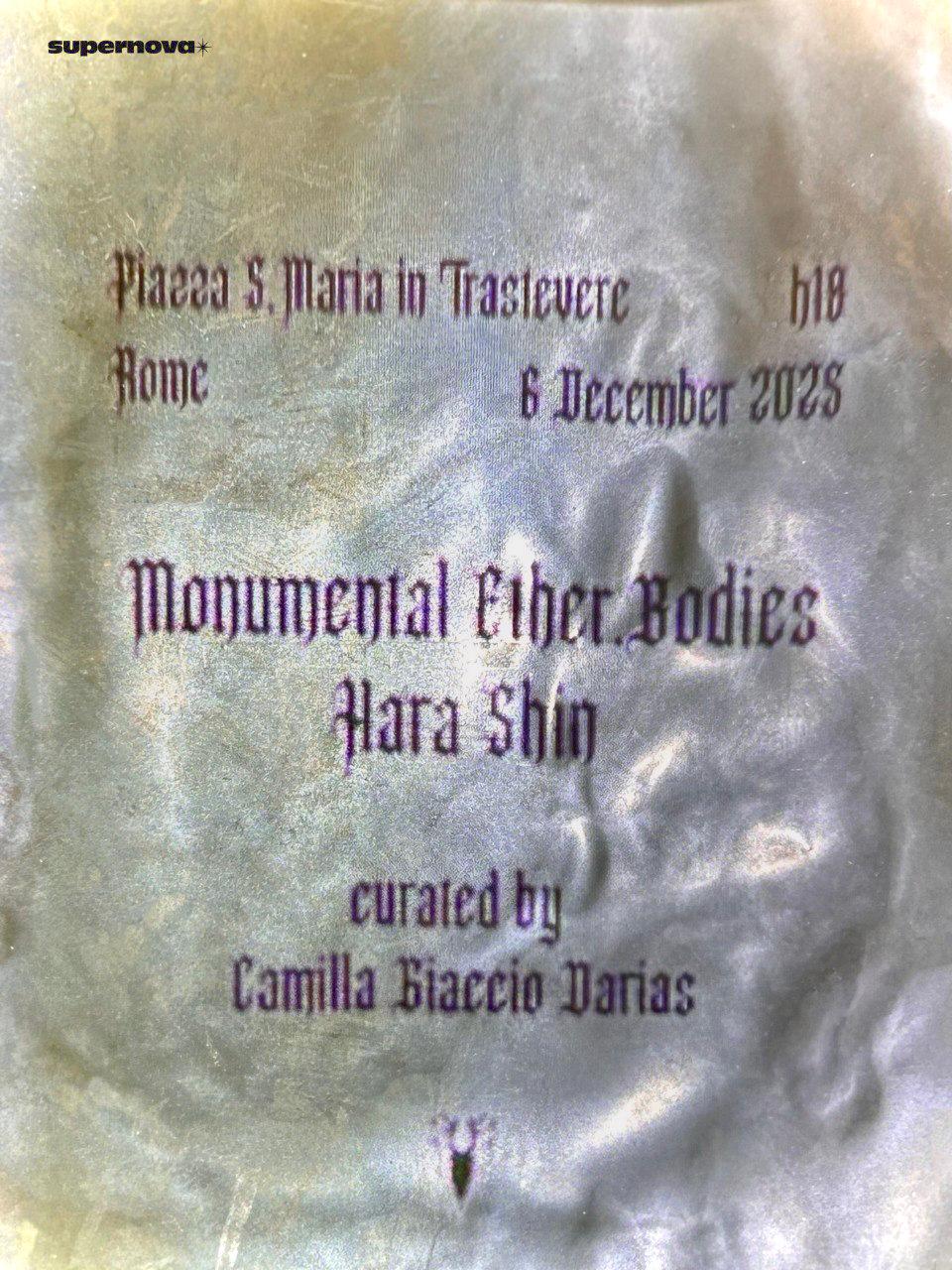
December 6 at 6pm
In collaboration with Hyperobjects we invite you to the opening of Monumental Ether. Bodies. by Hara Shin, curated by Camilla Giaccio Darias.
The exhibition presents a multichannel installation in which bodies traverse places marked by colonial and anthropocentric violence: the Kückenmühler Anstalten in Szczecin, a former Nazi sterilization center; the Tropical Botanical Garden in Lisbon, once a colonial garden; and the Tancheon Stream in Seoul, linked to the legend of the Taoist master Dongfang Shuo.
Touch emerges as a way of perceiving and relating to otherness: a gesture of trans-corporeal closeness with the forgotten. At the center is MOANA (Membrane; Outlander; Ancestor; Naming; Apparatus): a vibrating threshold, a witness to other histories, affections, and temporalities.
We look forward to seeing you!


Hara Shin 6 – 21/12, 2025
Monumental Ether. Bodies.
curated by Camilla Giaccio Darias
Stones remember what bodies try to forget,
and the dead breathe through the living.
Where does a body end?
– C.G.D.
In Monumental Ether. Bodies., different temporalities intertwine across landscapes scarred by colonial and anthropocentric violence: the Kückenmühler Anstalten in Szczecin—once a laboratory for Nazi sterilization and eugenic engineering; the Tropical Botanical Garden in Lisbon—the former Imperial Colonial Garden; and the Tancheon Stream in Seoul—surrounding the legend of the death of the Daoist immortal Dongfang Shuo. Three places shaped by dispossession and violence are now gentrified environments, seemingly “cleansed” of the atrocities embedded in their very architecture.
Nonetheless, suppressed histories re-emerge abruptly in the present, thickening the air with militarized borders, racial hierarchies, extractivism, genocides, and a planetary ecology collapsing under the weight of human exceptionalism. Hara Shin decides to connect with these places and moves through them with a renewed sensibility. In her work, bodies appear, overlap, transform, vanish… Hands slide across stone, water, bark, soil, moss, with inquisitive tenderness. Touch becomes an act of attunement to otherness: a refusal to forget, a negotiation with silence, a trans-corporeal proximity in which the realm of the dead rise through the living.
Shin invites us to listen through the porosity of our skin, expanding our sense of self across space in a tactile grammar of discovery. Guiding us through this journey is MOANA (M–Membrane; O–Outlander; A–Ancestor; N–Naming; A–Apparatus). An uncontainable fluctuating entity, neither human nor non-human, spirit nor matter. She lives across time and space, a testimony to the stories of the dead, the living, and the yet to be born. She generates the possibility of re-existence of what has been suppressed. She absorbs bodies, ideas, words, digesting and releasing them anew for us to re-experience. She evokes the spirit of Oswald de Andrade’s Manifesto Antropófago (1928), proposing cultural cannibalism as a practice of active resistance: to devour what dominates. Bodies unfold as relational, interwoven narratives that refuse enclosure within predetermined meaning.
What are we, anyway, if not permeable matter in constant negotiation with what surrounds and came before us? Skin learns what archives deny. There is no purity in life. We are made by many fleshes, and many histories– encountering, frictioning, intra-acting in magical erotic entanglements. A ceaseless becoming, visible and invisible matter unfolding through unpredictable contingencies. It is a cycle that we cannot escape—nor can we own—for we are it: in our cells, in our relationships, in our collective memories and desires. How liberating it is to feel one’s edges blur! As you feel your body sinking into the ground and the humid grass brushing against your feet, wait for MOANA to appear, along with the memory of those who once passed through here.
Words by Camilla Giaccio Darias
HISTORICAL CONTEXT
The Kückenmühler Anstalten in Szczecin (Poland) was founded in 1863 as a “reeducation center” for people diagnosed with mental illnesses. In 1933, under the Nazi Law for the Prevention of Hereditarily Diseased Offspring, the institute began performing forced sterilizations as part of the regime’s program of so-called “racial hygiene.” Victims included mentally divergent subjects, homosexuals, blind and deaf people, those with congenital disabilities, epilepsy, severe physical deformities, pregnant women diagnosed with “hereditary disease,” alcoholics, and anyone deemed “racially undesirable.” By 1938, the Kückenmühler had become the largest “care and assistance” institution in Pomerania, housing around 1,500 patients. When it closed in 1940, most were transferred to other facilities, where they were systematically murdered under Aktion T4, the Nazi euthanasia program targeting children and adults classified as “life unworthy of life.”
These killings formed part of the regime’s broader project of “racial improvement” and its violent attempt to impose a “purified” ideal on the German population.
The Lisbon Tropical Botanical Garden (Portugal) was founded in 1906 as the “Colonial Garden,” a site where plants from Portuguese colonies in Africa and Asia were gathered for acclimatization and economic exploitation. These institutions functioned as laboratories of classification, naturalizing hierarchies of value and domination. Indigenous plants—and the knowledge systems surrounding them—were reorganized through Western taxonomies, stripped of their cultural, medicinal, and spiritual meaning. The same logic was imposed onto colonized peoples, who were catalogued, measured, and displayed in ethnographic exhibitions that transformed living bodies into specimens. Taxidermy, too, embodied the colonial desire to possess. What could not be dominated alive was captured in death, preserved in glass
cases as evidence of mastery over “wild” nature. Behind the beauty and order these gardens underpin systematic violence: forced labor, land expropriation, murder, and the performance of imperial power. The supposed neutrality of science served as a veil, transforming theft into “discovery” and genocide into “progress.” The Tancheon Stream in Seoul (South Korea) is associated with the legendary death of the Daoist immortal Dongfang Shuo. According to tradition, Dongfang Shuo lived for three thousand cycles—a symbolic number evoking extraordinary longevity. The tale recounts that messengers of the underworld sought to capture him and, to deceive him, washed charcoal in the stream, darkening its waters. From this, emerged the name “Tancheon,” meaning “Charcoal Stream.”
Historically the Tancheon experienced severe environmental degradation due to rapid urbanization along Seoul’s southeastern edge. Domestic wastewater and industrial runoff polluted the river, while its natural flow was replaced by engineered channels, earning it the nickname “the river of death.” In recent decades, extensive ecological restoration has
transformed the Tancheon into a revitalized urban ecosystem. Native vegetation has been reintroduced, fish and bird populations have begun to recover, and walking and cycling paths now allow residents to re-engage with the river.
BIO
Hara Shin (South Korea/Germany) is a multidisciplinary artist whose research explores hybridity, embodiment, and the relationships between human and non-human entities, rethinking hierarchies, appropriation, and pluralism through experimental films and multimedia installations. Her work has been exhibited at institutions including DAZ Digital Arts Zurich held at Kunsthaus Zürich (2024), Space Heem, Busan (2024), Galerie Weisser Elefant, Berlin (2023), the 15th DMZ Documentary Film Festival (2023), TRAFO Center for Contemporary Art, Szczecin (2022), and Art Center Nabi, Seoul (2021). She was artist-in-residence at the Cité Internationale des Arts, Paris, and is the recipient of In Situ 2024–2025, supported by the Fondation Daniel et Nina Carasso. An alumna of the Goldrausch Künstlerinnenprojekt (2023), she was selected for the Emerging Visual Artist Support Program of the Arts Council Korea (2024). She studied at the University of the Arts Berlin (Meisterschülerin, 2021), Humboldt University of Berlin, and Hongik University, Seoul (BFA, 2011).
Camilla Giaccio Darias (Italy/Cuba) is a curator, writer, and researcher. Rooted in her Italo-Cuban heritage, she investigates how the diasporic condition can destabilize Western dualisms and revive ecological and transcultural perspectives in contemporary artistic practices. She is Curatorial and Editorial Coordinator of Hembryo Gallery (Rome), the physical extension of Hyperobjects. Her recent curatorial works include the performance Revelations of Divine Love by vvxxii, Cityofbrokendolls, Meuko! Meuko!, the exhibition Deep Time by Giuseppe Salis, the performative installation Shelly Wound by Linda Lach and Sofia Naglieri. She has collaborated with Short Theatre, MAXXI, studio GR*A, Alcova, and galleriaotto. She holds degrees in Literature, Art Business, Gender Studies and Politics, and Contemporary Art History from La Sapienza University (Rome), RomaTre University, and the Sotheby’s Institute of Art (London). Her writings have appeared in InsideArt, GRIOTmag, La Repubblica, Hyperobjects, Clearing Gallery (NY), The Armory Show (NY), Gratin Gallery (NY), and MAD54 Residency (NY).