
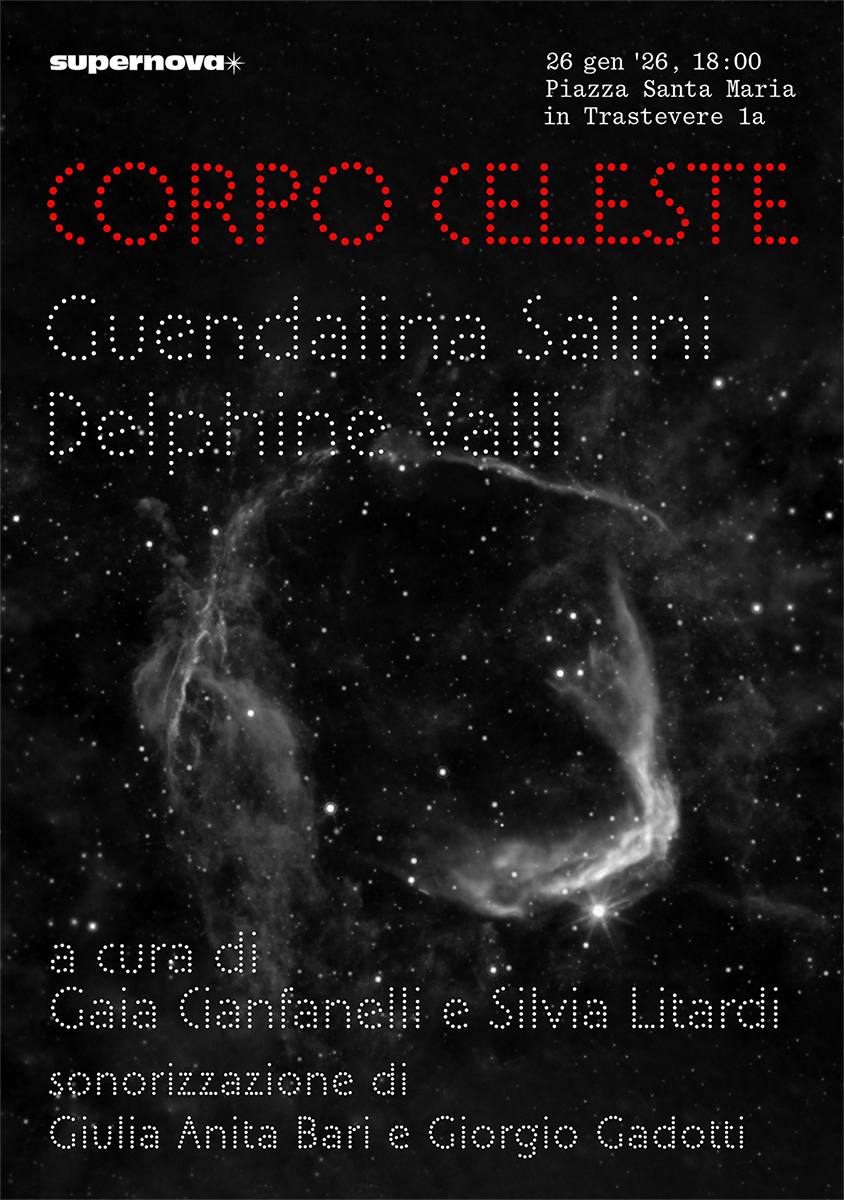
January 26 at 6pm
Supernova is pleased to invite you to Corpo Celeste, a two-person exhibition by Guendalina Salini and Delphine Valli, curated by Gaia Cianfanelli and Silvia Litardi.
Inspired by the idea that love is an orientation rather than a state of mind, the exhibition unfolds as a constellation of works where drawing, sculpture, and space enter into dialogue.
The opening will take place on Monday, January 26, 2026, with live sound improvisations by Giulia Anita Bari and Giorgio Gadotti.
The exhibition runs until February 15.
“Wherever there are eyes that look at you with peace or with fear,
there is something celestial, and it must be honored and defended.”
A. M. Ortese
On Monday, January 26, 2026, the exhibition Corpo Celeste opens in the spaces of Supernova in Rome—an encounter between the two artists Guendalina Salini (Rome, Italy, 1972) and Delphine Valli (Champigny-sur-Marne, France, 1972), curated by Gaia Cianfanelli and Silvia Litardi, with sound improvisations by Giulia Anita Bari and Giorgio Gadotti.
Conceived as a nebula of works that collide with one another, draw close, support each other, or reverberate into one another, Corpo Celeste arises from the intense dialogue the two artists have maintained over recent years—marked by a careful, reciprocal gaze on each other’s work, by the continuous exchange of research and readings, and by journeys toward many “Souths.”
This exhibition brings together Guendalina Salini’s figurative cycles and Delphine Valli’s sculptural elements—productions from the last five years of research, alongside environmental installations and site-specific interventions. The works appear in the Trastevere space in their autonomy, yet at the same time they take advantage of it to reveal their capacity to form alliances. The idea of labeling this exhibition as a “dual solo show” should be set aside; instead, one should be prepared to appreciate a work that extends into the shadow of another, the lightness of a drawing that offers itself as a banner in order to go beyond its own individual dimension.
The title of the exhibition, Corpo Celeste, is inspired by a collection of writings by Anna Maria Ortese—monologues in which moral and personal questions intertwine with reflections on existence. One can grasp forward-looking passages on interspecies thinking and on friendship—“life […] asks for friendship and help”—which recall another twentieth-century thinker dear to the artists, Simone Weil, for whom friendship (and love) is an orientation, not a state of mind. The subtitle of the exhibition, a quotation from Weil’s text Waiting for God, has the force of an axiom for the constitution of the exhibition project.
Ortese’s Corpo Celeste can be considered the “pretext for mediation” through which the investigations of the two artists opened up to dialogue. Rather than articulating a contrast between visual languages, in the zone of physical or projective contact between one artist’s work and the other’s, shared concerns brush against one another in a precise “here and now.”
Delphine Valli is an artist with a solid sculptural practice; she recounts having pared geometric forms down to a minimum—“I could take nothing more away”—to the point that in recent years she has given way to a research attentive to the intangible, composed of lights, wall drawings, and interventions that listen to space. Guendalina Salini has always used diverse media (including video, performative actions, drawing, ephemeral installations, and relational projects) to give form to poetic investigations often centered on inhabiting territories and dimensions of fragility; here she presents a production that is perhaps more intimate and detached from “thematic” cycles: charcoal drawing as a generative exercise.
In the exhibition, therefore, the works are presented in clusters with titles that combine the titles of individual works—for example: “Forests Burn, My Heart Is Black Charcoal. Armor of the Void,” “A Heron Lives in the Law. The Formation of Joy”—while other drawings, works on paper, and interventions alternate more freely.
On the opening night, Giulia Anita Bari, violinist, and Giorgio Gadotti, saxophonist, through the techniques of radical improvisation, interact with the works and with each other, using violin, saxophone, and ney, as well as materials connected to the artworks such as paper and iron, to make certain clusters resonate. The musicians listen to one another with their ears and welcome the sonic ideas that emerge from each other and back again. It is an immersive experience in which sound becomes an extension and interpretation of the visual works, exploring the potential of radical improvisation as an interactive expressive language and offering the audience a participatory sensory experience.
BIO
Guendalina Salini (Rome, Italy, 1972) lives and works in Rome. In London, where she earned a Master in Fine Art at Middlesex University, she began exhibiting with Sprovieri Art Gallery. Upon returning to Italy, she collaborated with various curators, exhibiting in Italy and abroad with galleries including Ex Elettrofonica (which represents her), ST Gallery, Francesca Antonini, Annalix Forever, Galerie Placido, and Galleria Valentina Bonomo, as well as with foundations such as Fondazione Pastificio Cerere, Fondazione Fendi, Fondazione Baruchello, Auditorium – Fondazione Musica per Roma, and in major Italian museums including MAXXI – National Museum of 21st Century Arts and MACRO in Rome, the Italian Geographic Institute, and the Museo Bilotti. Her video work has been shown at film festivals (Locarno, Rome, Ismaila).
She has led workshops and participatory projects with organizations such as Eccom and Fondazione per il Sud, Start, Oikos, MAAM – Museum of the Other and Elsewhere, Teatro Valle, AlbumArte, Latitudo, and Laboratorio di Città Corviale. She regularly organizes inclusive and participatory artistic projects with other artists and performers. In 2017 she founded the association La Frangia together with Giulia Anita Bari, with the aim of uniting art and human rights.
Delphine Valli (Champigny-sur-Marne, France, 1972) lives and works in Rome, where she graduated in Sculpture from the Academy of Fine Arts in 2002. Her artistic research originates from a fascination with observing the surrounding environment. She explores the relationships created between artistic intervention and space, involving it as a plastic element.
In 2021 she won the Italian Council (10th edition), a research grant with an international residency at LE 18 in Marrakech, Morocco, and in 2022 a research grant from the Institut Français Alger with a residency at La MaisonDAR in Algiers, Algeria.
She has exhibited her work in galleries, public, and institutional spaces including Building, Milan; MANIFESTA 13, Marseille; AlbumArte; Institut Français; MAXXI – National Museum of 21st Century Arts; Accademia Nazionale di San Luca; Ex Elettrofonica in Rome; CIAC, Genazzano; and the 26th Sculpture Biennial at Palazzo Ducale, Gubbio.
She is a lecturer in Multimedia Installations and Performative Techniques for the Visual Arts at the Academy of Fine Arts of Venice.
Giulia Anita Bari (Venice, Italy, 1983) studied classical violin at the “B. Marcello” Conservatory in Venice and concurrently earned degrees in International Relations and the philosophy of human rights at the University of Padua, and in European Union Law at the University of Florence. She works for numerous international organizations and NGOs in Italy and abroad (UNHCR, ActionAid, Oxfam, MEDU, SCI, Terra!), combining her musical path with humanitarian engagement in the field. She founded the Orchestra dei Braccianti, a project presented at TEDx and on the stages of major Italian world music festivals, and Nubras Ensemble. She collaborates with classical orchestras and ensembles in Italy and abroad and was a member of the Orchestra Fonterossa led by Silvia Bolognesi.
Giorgio Gadotti (Trento, Italy, 1990) is a multi-instrumentalist with an eclectic and international artistic path. From a young age he studied guitar under Maestro Enrico Merlin. During his university years, he took up the accordion as a self-taught musician and, after earning a degree in Political Science, undertook a long journey that led him to live for five years across three continents, constantly searching for new musical languages. He holds a degree in alto saxophone from Siena Jazz and is a co-founder of the Nubras Ensemble. He was also part of the Orchestra Fonterossa led by Silvia Bolognesi.
Link to Audio files


